
Wisconsin’s Housing Challenge Calls for More Homes, More Partnership

Housing affordability has become one of Wisconsin’s most urgent economic and community challenges — and one of the few issues where there is real opportunity for bipartisan progress.
It affects urban neighborhoods and rural communities. Young adults starting their lives and families putting down roots. Employers seeking workers and communities looking to grow. Renters, homeowners, developers, local governments and nonprofit organizations all experience different parts of the same challenge.
While we may disagree about some of the solutions, we should be able to agree on something fundamental: Wisconsin needs more housing, greater affordability and fewer challenges standing between people and a stable place to call home.
The numbers are difficult to ignore.
Wisconsin’s median home sales price increased by more than 50% over a five-year period while median household income increased by about 20%. Housing experts estimate Wisconsin will need more than 200,000 additional housing units by 2030 to meet projected demand.
That is not simply a housing problem. It is a workforce problem. An economic competitiveness problem. A family stability problem. And, for some of the young people we serve at Wellpoint Care Network, it can determine whether the transition into adulthood begins with opportunity or instability.
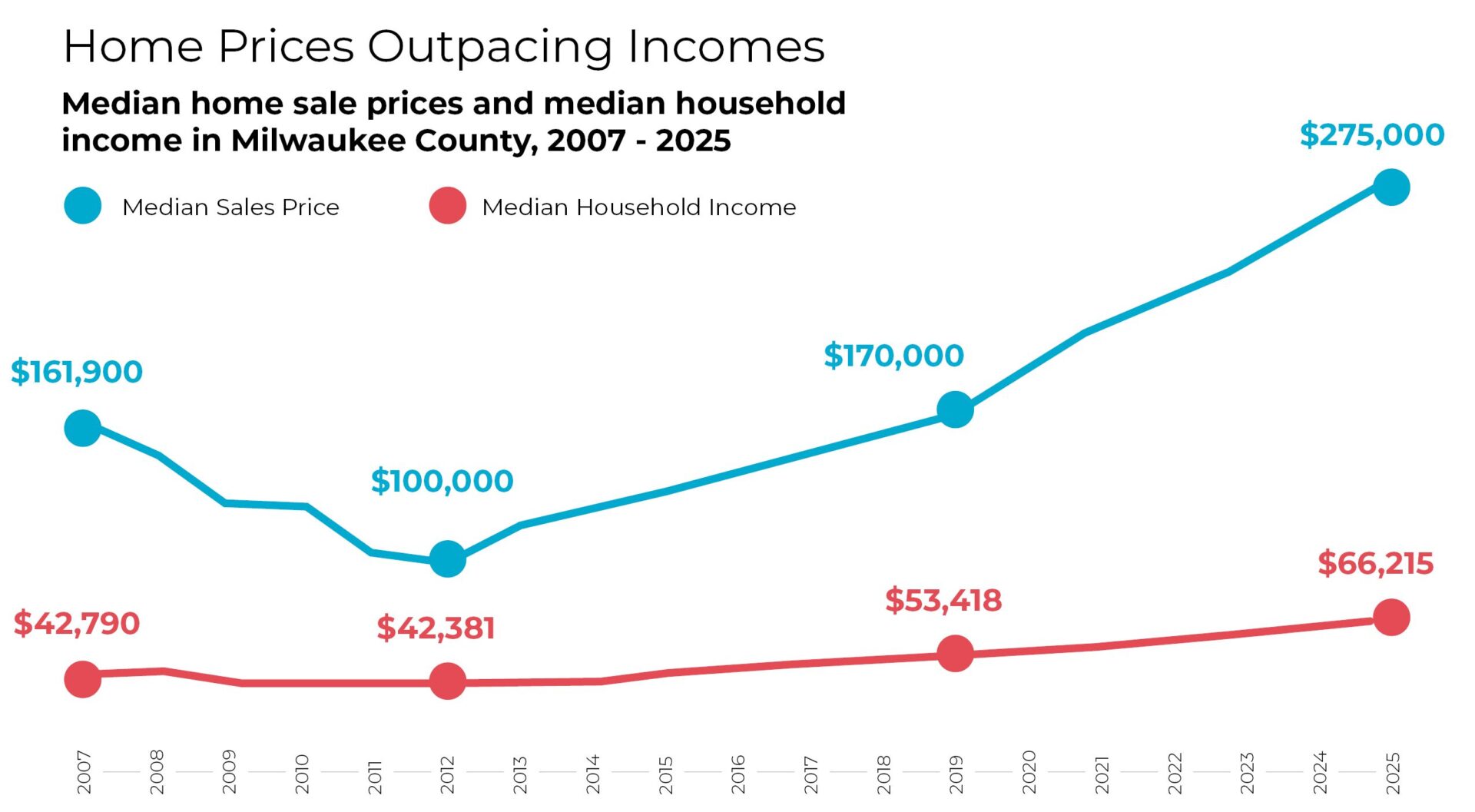
Young adults leaving foster care and other systems of care frequently enter adulthood without many of the supports others take for granted: established credit, rental history, a cosigner, family financial assistance or simply someone to call when something goes wrong. Stable housing provides the foundation to pursue education, maintain employment, care for their health and build independent lives.
But the challenge of helping people navigate the housing market is compounded in a state that is not producing enough housing to keep pace with demand.
Earlier this year, Wellpoint Care Network convened more than 60 leaders from the housing, business, development, philanthropy, workforce development, government, public policy and the nonprofit sectors, along with young adults who brought their own lived experiences to the conversation. The perspectives were diverse, but an important consensus emerged: no single sector, organization, or level of government can solve this challenge alone.
That conversation reinforced three main principles that can help move Wisconsin forward. We addressed these in a report titled Opening Doors: Creating Housing Opportunities for Young Adults, which you can download below.

Opening Doors
Creating Housing Opportunities for Young Adults
Stable housing is the foundation that makes education, employment, health, and long-term stability possible, but no single organization can solve Wisconsin’s housing challenges alone. This paper examines five key questions uncovered at our Opening Doors Breakfast Discussion, as well as ways different sectors can work together to make things better.
Download Now ( 8 MB PDF )
1) We have to make it easier to build housing.
Housing production has been constrained by years of underbuilding, rising construction costs, financing challenges and regulatory complexity. Local zoning and approval processes can add time, uncertainty and expense to projects. Costs that ultimately affect the pace of construction and what families pay. While regulations can protect communities and consumers, outdated or duplicative processes can also have a deleterious effect.
We should regularly ask whether regulations and approval processes still serve a meaningful purpose or whether some have simply accumulated over time and now make housing unnecessarily difficult and expensive to produce.
Wisconsin and communities across the country are experimenting with approaches that encourage production, including streamlined approvals, smaller lot sizes, more flexibility for duplexes and other housing, commercial conversions and infrastructure financing. Wisconsin has enacted bipartisan housing legislation designed to expand workforce and affordable housing opportunities.
That should encourage us. Housing does not have to become another partisan battlefield.
2) Increasing supply and addressing affordability are not competing objectives.
We need market rate housing. We need workforce housing. We need starter homes. We need affordable rental options. And we need targeted support for young people and families for whom even an improved housing market may remain difficult to navigate.
A healthy housing strategy should create more choices, not prescribe one solution for every community.
3) Government cannot solve this alone. Neither can the private sector.
Employers understand the relationship between housing and workforce stability. Developers understand what prevents projects from becoming financially viable. Community organizations understand the challenges families encounter. Philanthropy can help test innovative approaches. Government can modernize policies, align resources and remove unnecessary obstacles.
“We all know that one organization, one level of government certainly cannot do everything alone.
It requires partnership.”MILWAUKEE MAYOR CAVALIER JOHNSON
After our recent convening where these findings came to light, Wellpoint Care put together a housing report. It highlights examples of what can happen when those interests come together from public-private partnerships supporting affordable homeownership to better coordination among organizations already serving young adults.
That is the opportunity before Wisconsin.
We do not need to choose between compassion and economic discipline, between helping people and making markets work better, or between public leadership and private initiative.
We need all of them.
Let’s continue the conversation
At Wellpoint Care Network, our work with young people and families has taught us that housing is about much more than four walls and a roof. It is about stability, employment, health, education and the opportunity to build a future.
As we release our housing affordability paper, our hope is that it serves not as the final word but as a starting point for a broader conversation about what Wisconsin can do next. We’re committed to leading this conversation.
The challenge is significant. But so is the opportunity.
If we reduce unnecessary barriers, increase housing production, make better use of resources already available and build stronger partnerships across sectors, we can create more pathways to homeownership, greater housing stability and stronger communities.
That is not a Republican solution or a Democratic solution.
It’s a Wisconsin solution — and it’s work worth doing together.
Reggie Newson is the President and CEO of Wellpoint Care Network.